
What is the Correct Distance of a Synthetic Lash from the Eyelid? Tips for Lash Stylists
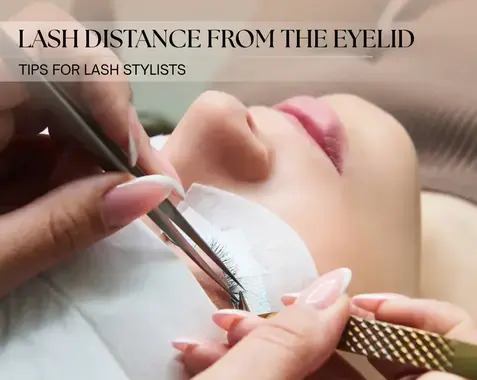
The correct distance of a synthetic lash from the edge of the eyelid is crucial – it affects both the appearance of the styling and the comfort and health of the client.
In this article, you will learn:
➤ What is the correct distance of a synthetic lash from the eyelid?
➤ What are the consequences of attaching lashes too close or too far?
➤How to visually assess the correct distance of the synthetic lash from the eyelid?
Correct Distance of Synthetic Lashes from the Eyelid
During training, it is commonly stated that the correct distance of a synthetic lash from the edge of the eyelid is about 0.2–0.5 mm. Although this is the correct range, for many stylists, these values are difficult to imagine. You work on a microscopic scale, and each millimeter looks different depending on the thickness, length, and growth direction of natural lashes.
That’s why, aside from theoretical knowledge, visual and aesthetic sensitivity is just as important. The key is to learn how this distance looks “in real life” under the lamp, from the stylist’s perspective, not just on a diagram or description.
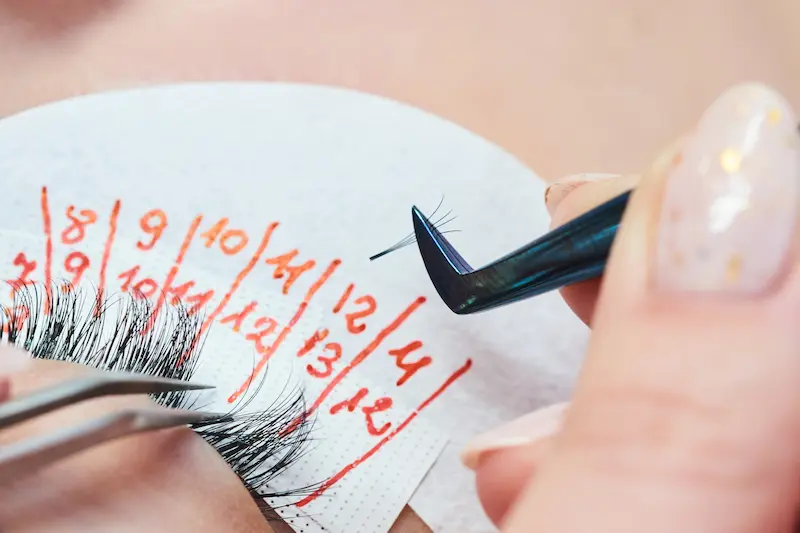
Consequences of Too Close AttachmentAttaching the synthetic lash too close to the edge of the eyelid may initially look aesthetically pleasing as it lifts the natural lash and creates an attractive line. However, in practice, it carries serious consequences:
| Consequences of Too Far AttachmentAttaching the synthetic lash too far from the edge of the eyelid is also not a solution. While it eliminates the risk of irritation, it causes other problems:
|
Ideal Distance – Theory and Practice
Theoretically, the correct distance should fall within the range of 0.2–0.5 mm from the eyelid edge. In practice, however, the most important thing is that:
- The synthetic lash does not touch the skin,
- It does not create a visible “gap” or regrowth effect on the first day of application,
- The entire lash line has a uniform distance from the eyelid.
The distance must be adapted to the client’s eye anatomy – with deeply set eyes or strongly curved natural lashes, it may look slightly different, but it should still meet comfort and safety requirements.
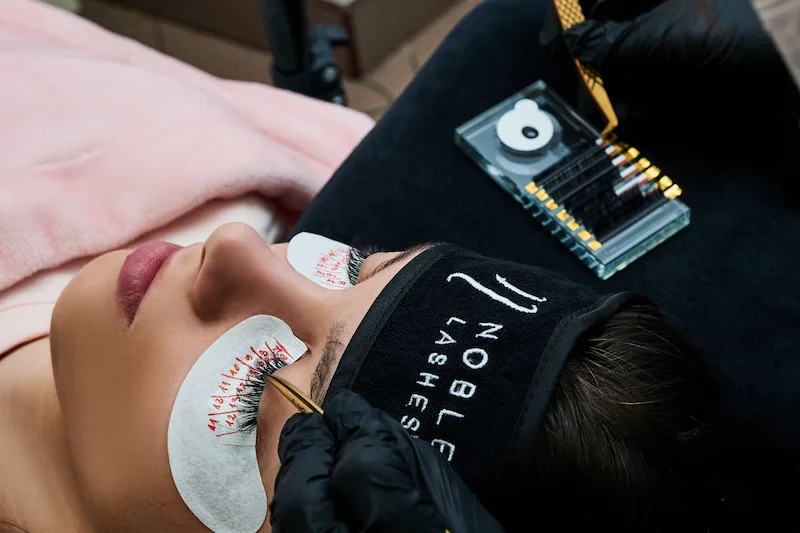
How to Visually Assess the Correct Distance of the Synthetic Lash from the Eyelid?
From the stylist's perspective, when the client lies on your treatment bed, you see:
- The lash line,
- The natural lashes growing from it,
- The point where the natural lash “emerges” from the eyelid and begins its length.
You should attach the synthetic lash just above the point where the natural lash emerges from the eyelid, leaving a small but invisible buffer. If you see that:
- The synthetic lash “touches” the skin – it’s too close,
- A clear gap appears – it’s too far.
The most important thing is that every synthetic lash is attached at a similar distance, creating a harmonious, even line and a professional final effect.
 Tip: Instead of focusing on "perfect" millimeters, observe the styling as a whole. A uniform line, no irritation, and no visible regrowth on the first day is a sign that the distance is correctly chosen.